
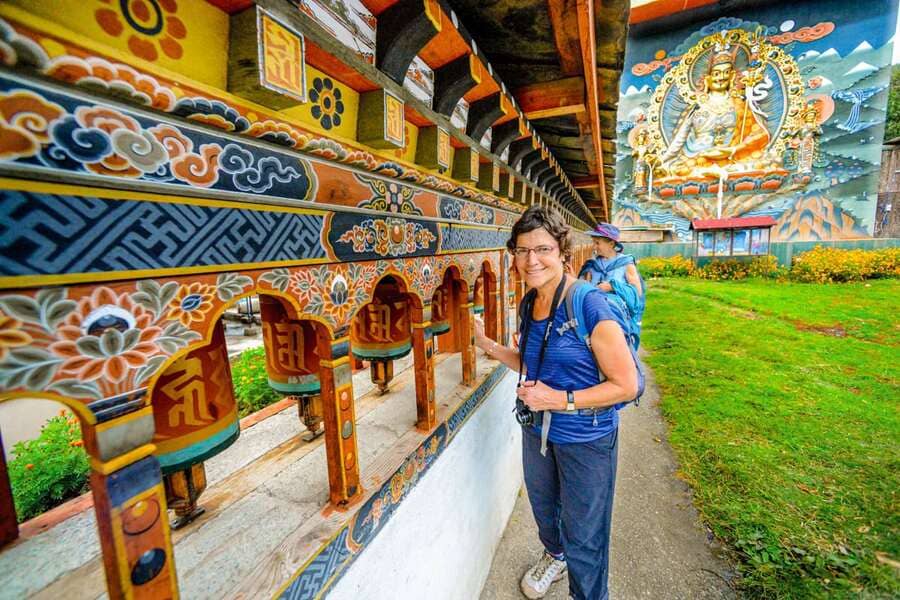
Seven days in Bhutan is enough to understand why people come back.
It is not enough to see everything - no journey is, in a country this layered. But seven well-designed days in the right order, with the right pacing, take you from the airport approach over Bhutan's folded Himalayan ridges to a Tiger's Nest meditation cave, from a medieval fortress at a river confluence to a rice field walk toward a temple of the Divine Madman. Seven days is enough for Bhutan to do what it does to people: quietly, irreversibly, change the way you see the world.
Among the many Bhutan tours available today, this itinerary follows the route that consistently delivers the most rewarding introduction to the kingdom. It is the journey we have refined over nearly two decades of guiding travelers through this extraordinary country — carefully adjusted for pacing, altitude acclimatization, experience sequencing, and the kind of spontaneous encounters that only happen when you are not rushing between destinations.
The itinerary covers Bhutan's essential western circuit, linking Paro, Thimphu, and Punakha through a series of cultural, historical, and scenic experiences that reveal the country's unique character. For travelers with additional time, it can also be extended to the beautiful Gangtey Valley, adding another dimension to one of the most popular Bhutan tours for first-time visitors.
Why 7 Days Is the Ideal Introduction to Bhutan
A common question from first-time visitors is whether to come for 5 days or 10. Five days leaves you constantly aware of what you are missing. Ten days, for a first visit, can feel slightly overwrought without broader regional context.
Seven days, by contrast, hits a natural sweet spot. It allows genuine acclimatization — important at Bhutan's altitudes. It allows for the unhurried pacing that makes Bhutan meaningful rather than merely scenic. And it allows for the moments that do not appear on any itinerary: the conversation with a monk at a temple courtyard, the farmhouse family who insists you stay for another bowl of butter tea, the unexpected festival procession blocking the road in the best possible way.
The western circuit - Paro, Thimphu, Punakha - covers Bhutan's most celebrated landmarks and its cultural and historical heartland. For 95% of first-time visitors, it is the right place to spend a first week.
A Summary of Your 7-Day Bhutan Journey
| Day | Location | Highlights |
|---|---|---|
| 1 | Paro | Arrival, Paro Valley orientation, Rinpung Dzong |
| 2 | Paro | Tiger's Nest Monastery hike (Paro Taktsang) |
| 3 | Paro → Thimphu | Kyichu Lhakhang, drive to capital, Thimphu evening |
| 4 | Thimphu | Buddha Dordenma, Memorial Chorten, Folk Heritage Museum, Changangkha Monastery |
| 5 | Thimphu → Punakha | Dochula Pass, arrive Punakha Valley |
| 6 | Punakha | Punakha Dzong, Chimi Lhakhang, farmhouse lunch |
| 7 | Punakha → Paro | Return journey, farewell dinner, departure |
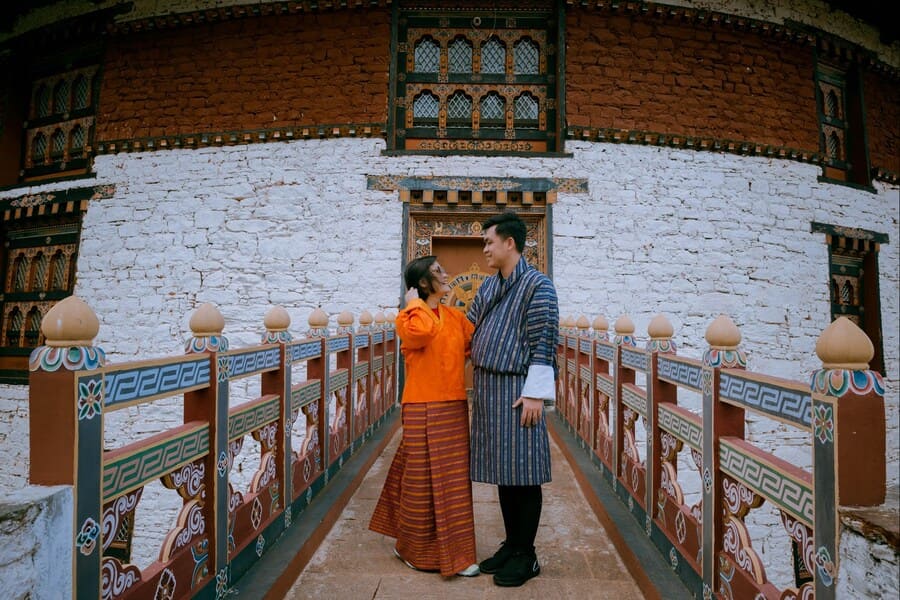
Day 1: Arrival in Paro — First Impressions of the Dragon Kingdom
The approach to Paro International Airport is unlike any other landing on earth. The valley is narrow, the mountains close on both sides, and only a handful of pilots in the world are certified to navigate it. As the aircraft banks steeply between ridgelines, the Paro Valley suddenly appears below you — flat farmland, whitewashed farmhouses, a fortress on a hillside — and you understand, before you have even touched down, that you have arrived somewhere genuinely different.
After clearing customs and immigration (your guide will meet you with a warm welcome outside the terminal), the first hours in Bhutan are about orientation and acclimatization rather than sightseeing. Paro sits at approximately 2,200 metres — high enough that some visitors feel slightly lightheaded, particularly those arriving from sea-level cities. Drink plenty of water, avoid alcohol on the first evening, and let your body adjust.
Afternoon
A gentle introduction to Paro. Walk along the Paro Chhu (river), visit the weekend market if timing aligns, or stroll through the town's main street — a short, photogenic strip of traditional Bhutanese shopfronts with carved wooden facades.
Late Afternoon
Drive up to Rinpung Dzong (Paro Dzong) for an initial orientation. This fortress monastery — the setting for the annual Paro Tsechu festival — sits above a cantilever bridge with views across the valley. You will return here in more detail, but the initial view at late afternoon light is worth the short drive.
Evening
Dinner at your hotel or a local Paro restaurant. Try ema datshi (chili and cheese stew), the national dish, from day one. It is spicier than most Western visitors expect — but it is also deeply delicious, and you will want it again.
Where to Sleep
Paro. Accommodation ranges from simple guesthouses to boutique lodges. For a first-night impression, a mid-range property with a valley view is ideal — waking to the Paro Valley at dawn on your first morning in Bhutan is a memory that stays.
Day 2: Paro Valley — Tiger's Nest Hike and Cultural Depth
This is the day. Everything else is prelude.
Morning
The Tiger's Nest hike begins early — aim to be at the trailhead by 8:00 AM. The hike to Paro Taktsang (Tiger's Nest Monastery) takes 2–3 hours uphill, depending on pace, followed by 45–60 minutes inside the monastery complex and 1.5–2 hours back down. Allow a full morning and early afternoon.
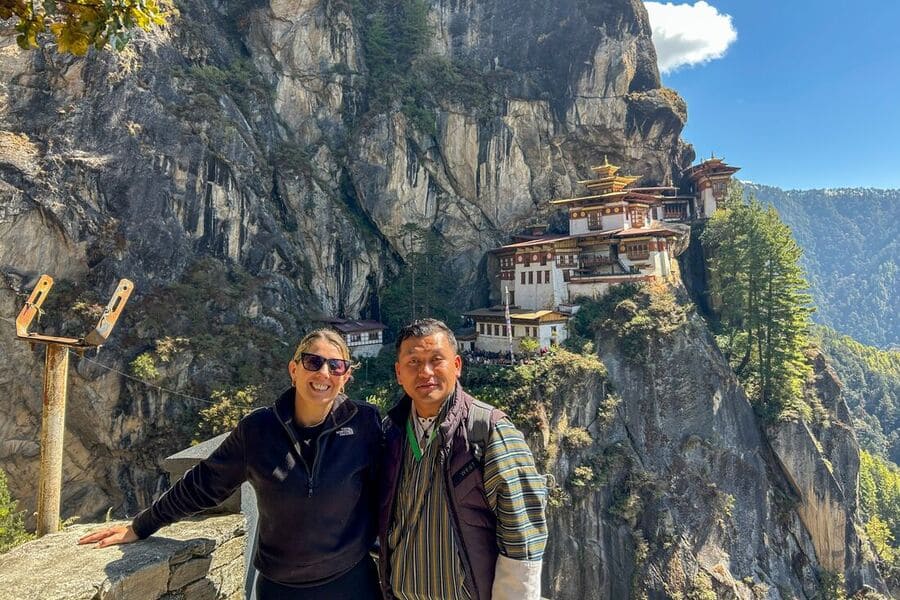
The trail climbs through pine forest, opens to the first viewpoint of the monastery perched on its impossible cliff, passes the midpoint cafeteria (pause for tea and the view), then descends into a gorge past a waterfall before the final steep staircase ascent to the monastery gate.
Inside the four main temples — including the Pelphug, the original meditation cave of Guru Rinpoche — photography is strictly prohibited. Leave your camera at the gate, cover your shoulders and legs, remove your shoes at each threshold, and allow yourself to simply be present. The atmosphere inside Paro Taktsang has a quality that most visitors find genuinely moving.
Afternoon
Return to Paro for lunch, then visit Kyichu Lhakhang — one of Bhutan's two oldest temples, built in the 7th century by the Tibetan Emperor Songtsen Gampo. The grounds feel alive with pilgrims, spinning prayer wheels, and the smell of juniper smoke. It is a calm counterpoint to the physical drama of the morning.
Evening
Rest, reflection, and a good dinner. Day two in Bhutan tends to produce a particular kind of exhaustion — physical from the hike, but also the deep tiredness that comes from encountering something genuinely extraordinary. Let it settle.
Day 3: Paro to Thimphu — Ancient Temples and the Capital Revealed
The drive from Paro to Thimphu takes approximately 1.5 hours along the Wang Chhu River valley. It is a beautiful drive — through river gorges, past prayer wheel corridors on riverside rocks, through small villages where monks in crimson robes move unhurriedly between temple and kitchen.
Morning (Before Departure)
If timing allows, a brief visit back to Rinpung Dzong for a more detailed exploration — the interior courtyards, the monks' quarters, the administrative chambers that host the annual Paro Tsechu.
En Route
Stop at Tamchhog Lhakhang, the bridge-builder saint's temple, accessible via a traditional iron chain suspension bridge. This is one of Bhutan's more unusual temples and one that many itineraries skip — your guide will know whether timing permits.
Arrival in Thimphu
Bhutan's capital is small by any international standard — about 150,000 people — but it is the beating administrative and cultural heart of the kingdom. It contains the national parliament, the throne room of the king, the largest monastery in Bhutan, and some of the country's finest restaurants.
Afternoon in Thimphu
Begin with a walk through the Centenary Farmer's Market (Thimphu Weekend Market) if your visit falls on Friday–Sunday — a sensory immersion into Bhutanese agricultural and handicraft production. Chilies, local cheese, dried yak meat, hand-woven fabrics, incense. A genuine market, not a tourist production.
Evening
Thimphu's main street (Norzin Lam) for a walk, and dinner at one of the capital's restaurants. Thimphu has the most varied dining of any Bhutanese city — Indian, Thai, and international options supplement traditional Bhutanese cooking.
Day 4: Thimphu — The Capital's Depth
A full day in Thimphu reveals a capital that rewards slow exploration.
Morning
Drive to Kuensel Phodrang for Buddha Dordenma — a 169-foot gilded bronze statue of Shakyamuni Buddha, built in fulfilment of an ancient prophecy of Guru Rinpoche. The scale is genuinely astonishing, and the views from the terrace across the Thimphu Valley and to the surrounding forested ridges are exceptional. Inside the statue's base, 100,000 smaller Buddha figures are enshrined.
Mid-Morning
Memorial Chorten (National Memorial Stupa), built in memory of the third King, Jigme Dorji Wangchuck. This is the most important chorten in Thimphu and a major site for local devotional practice — elderly Bhutanese circumambulate it continuously through the day, spinning prayer wheels and murmuring mantra. It is one of the most quietly affecting experiences in the capital.
Afternoon
Changangkha Lhakhang — Thimphu's oldest and most atmospheric temple, perched above the city on a promontory with commanding views. Built in the 12th century, it is the place where Thimphu families bring newborns to receive names from the resident monk. The walk up through traditional neighbourhood lanes is as much an attraction as the temple itself.
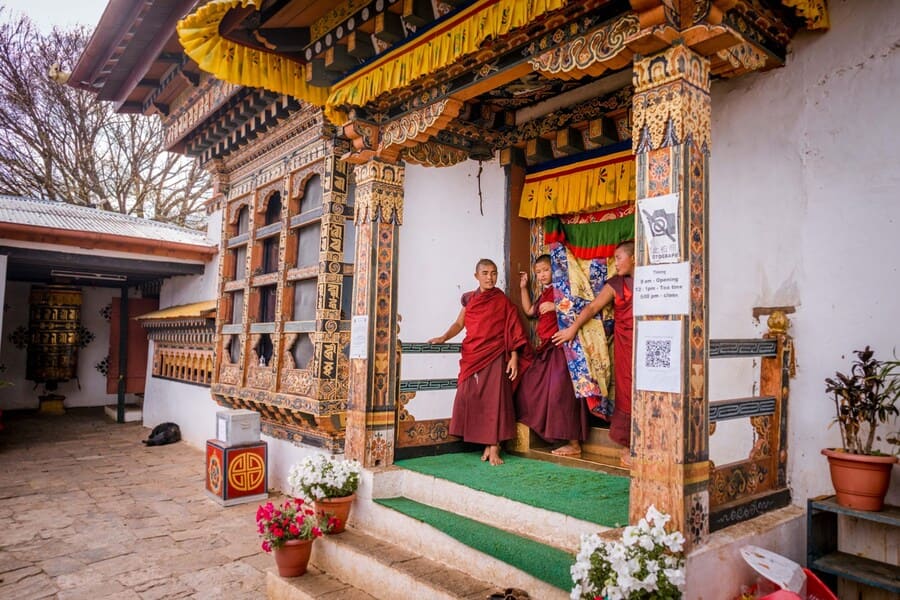
Follow with the Folk Heritage Museum near the river — a beautifully preserved traditional Bhutanese farmhouse whose three floors walk you through the daily life of a rural Bhutanese family across different periods of history. Household objects, farming tools, weaving equipment, kitchen rituals.
Evening
If your visit falls on a Thursday evening, enquire about a traditional archery competition — a genuinely local affair with lively sideline singing, dancing, and elaborate trash-talking that has nothing to do with tourism. Your guide will know if one is happening.
Day 5: Thimphu to Punakha — Over Dochula Pass
The drive from Thimphu to Punakha takes approximately 2.5–3 hours, crossing the Dochula Pass at 3,116 metres. It is one of the most beautiful road journeys in Bhutan and one of the most photographed spots in the country.
Dochula Pass
On a clear day — and autumn and spring tend to oblige — the pass offers a panoramic view of the Eastern Himalayan range that includes some of the highest peaks in the world. The 108 chortens built in memory of Bhutanese soldiers, the Druk Wangyal Chortens, stand in a tight cluster against the sky. In winter, snow covers everything and the mountain backdrop sharpens dramatically.
The pass is also the starting point of one of Bhutan's most rewarding short hikes: the trail to Lungchutse monastery, a 2-hour round trip through rhododendron forest to a small temple with exceptional views. Worth the detour if time allows.
Arrival in Punakha
As the road descends from Dochula, the temperature rises noticeably. Punakha sits at approximately 1,200 metres — notably warmer and more fertile than Thimphu or Paro. The valley is wide, green, and dramatic: rivers on either side, forested hills rising sharply, and the impossible dzong at the confluence of the Mo Chhu and Pho Chhu rivers visible from the road.
Afternoon
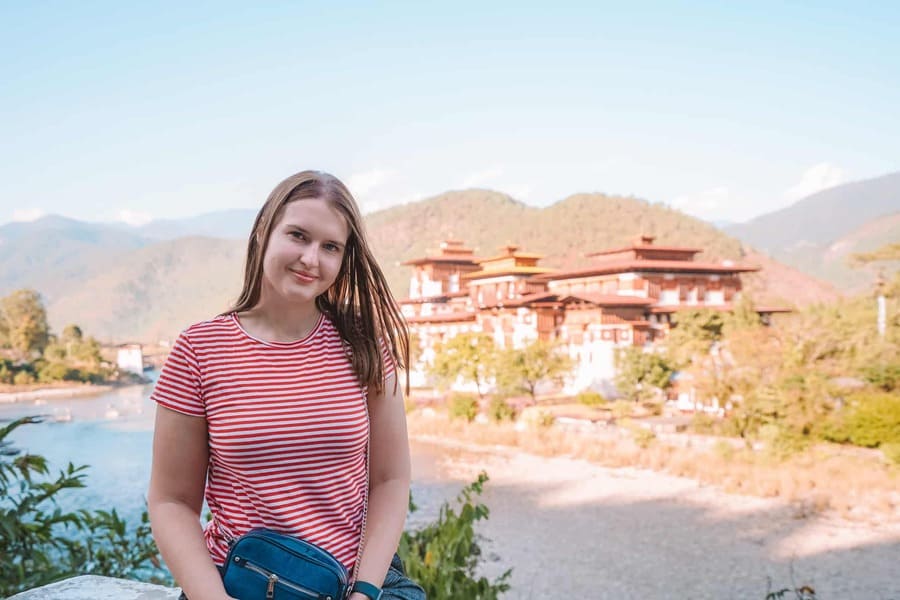
A first visit to Punakha Dzong — arguably the most beautiful building in Bhutan, and one of the most beautiful in Asia. Built in 1637 at the meeting point of the Mother River (Mo Chhu) and Father River (Pho Chhu), the dzong served as Bhutan's capital for three centuries. It remains the winter residence of the Je Khenpo (Chief Abbot) and the seat of Bhutan's monastic body. The royal wedding of the current king and queen was held here in 2011.
Enter through the cantilever bridge, past the massive entrance gate, into a succession of courtyards. The interior murals and thangka paintings are extraordinary. The dzong's three towers reflect in the river below. In spring (February–March), jacaranda trees surrounding the dzong bloom in vivid purple — one of the most photographed sights in Bhutan.
Day 6: Punakha — Valley Depth and Sacred Encounters
A full day in Punakha Valley is one of the great pleasures of a Bhutan itinerary. The pace here is naturally slower, the landscape more open, the sense of arrival more complete.
Morning
Walk to Chimi Lhakhang — the Fertility Temple of Bhutan. The walk begins in the village of Lobesa and crosses a suspension bridge, then follows a path through rice paddies to the white temple on a gentle hill. The path itself is one of the most beautiful short walks in Bhutan.
Chimi Lhakhang was built in 1499 in honour of Drukpa Kunley — the "Divine Madman" — a revered Buddhist saint whose unconventional approach to enlightenment involved laughter, folk wisdom, and the use of, shall we say, distinctive iconography. The temple is famous throughout Asia as a blessing site for couples hoping to conceive. Your guide will explain the tradition with the equanimity that only extensive practice can produce.
Late Morning
Return via the rice fields, stopping at a local farmhouse for butter tea and conversation — or, if your operator has arranged it, a full farmhouse lunch with a Bhutanese family in the valley. Sitting around a low Bhutanese table, eating local red rice and ema datshi prepared by a family who has never thought of their home as a tourist attraction, is among the most memorable meals you will have on any journey anywhere.
Afternoon
The Khamsum Yulley Namgyal Chorten — a newly built four-storey temple on a hillside above the north bank of the Mo Chhu. The 45-minute hike through rice terraces and apple orchards to reach it is rewarding in itself. The interior contains beautiful murals of deities subduing negative forces, and the views across Punakha Valley from the top terrace are exceptional.
For the more adventurous: white-water rafting on the Mo Chhu — a half-day activity that takes you through the valley on a gentle-to-moderate section of river, with views of the Punakha Dzong from the water. Arrange in advance with your operator.
Evening
Dinner in Punakha. A quiet evening — Punakha is not a nightlife destination — but the stars above the valley on a clear night are extraordinary. Altitude and minimal light pollution produce a sky that urban travelers rarely see.
Day 7: Return to Paro — Reflection and Departure
Morning
The return drive to Paro (approximately 3–3.5 hours via Thimphu, or slightly shorter via the direct Wangdi route) offers a final chance to absorb the landscape — the rivers, the dzongs on distant hillsides, the prayer flags strung across mountain passes.
If your flight is in the afternoon or evening, there is time for final activities in Paro: revisiting the town bazaar for last-minute souvenirs (hand-woven fabrics, incense, traditional Bhutanese stamps, red rice, and locally produced honey are all excellent choices), a final walk along the Paro Chhu, or a visit to the National Museum of Bhutan (Ta Dzong) just above Rinpung Dzong.
Farewell Dinner
If time allows before departure, a final Bhutanese meal — take the opportunity to order anything you did not try earlier in the week. The ara (local distilled spirit), served warm with an egg, is a traditional Bhutanese farewell drink.
Departure
The flight out of Paro is as dramatic as the arrival. As the aircraft climbs steeply from the valley and the mountains close in around you, you will have one final view of the Paro Valley below — the fortress, the fields, the river. For most travelers, this is the moment they begin planning to return.
Optional Extension: Adding Gangtey Valley (Days 8–9)
If you have two additional days, adding Gangtey (Phobjikha Valley) transforms a great itinerary into an exceptional one.
The drive from Punakha to Gangtey takes approximately 3 hours over the Pelela Pass. The valley is one of Bhutan's most beautiful: a wide, flat-bottomed glacial valley at 2,900 metres, dominated by the ancient Gangtey Gonpa (monastery) and protected as a conservation area.
From October to February, the valley is the winter home of the rare black-necked cranes, which arrive each year from their breeding grounds in Tibet and roost in the marshes below the monastery. The Gangtey Nature Trail — a 3-hour loop through the valley, the wetlands, and several traditional villages — is one of the finest walks in Bhutan.
A night or two in Gangtey, staying at the Gangtey Lodge (luxury) or a local guesthouse, adds a layer of wilderness and cultural quiet that even the western circuit's richness cannot provide.
Accommodation Recommendations by Budget Tier
Budget
Paro (Kichu Resort or similar), Thimphu (Phuntsho Pelri Hotel), Punakha (Meri Puensum or similar). Clean, comfortable, local character, typically USD 60–100 per room.
Mid-Range
Paro (Naksel Boutique Hotel & Spa), Thimphu (Druk Hotel or Taj Tashi), Punakha (Dhensa Boutique Resort). Excellent quality and setting, typically USD 120–250 per room.
Luxury
Paro (COMO Uma Paro, Amankora Paro), Thimphu (Taj Tashi, Amankora Thimphu), Punakha (Amankora Punakha, COMO Uma Punakha). World-class hospitality in extraordinary settings, USD 400–1,200+ per room.
How to Book Your 7-Day Bhutan Tour
All visits to Bhutan must be arranged through a licensed Bhutanese tour operator. Your operator handles visa arrangements, SDF payment, guide assignment, accommodation booking, and all internal logistics.
Our specialists at Go Bhutan Tours have designed and operated itineraries like this one for nearly two decades. Every journey we create is built around a specific traveler - your pace, your interests, your accommodation preferences, your timing. Start planning your tailor-made Bhutan journey with a free consultation and detailed cost breakdown within 12 hours.
FAQs About a 7-Day Bhutan Itinerary
Is 7 days enough for Bhutan?
Yes - for a first visit to western Bhutan. Seven days allows you to experience the essential circuit (Paro, Thimphu, Punakha) at a genuinely unhurried pace. To add Bumthang, Gangtey, or eastern Bhutan, 10–14 days is recommended.
What is the best route for a 7-day Bhutan trip?
The classic circuit - Paro (2 nights), Thimphu (2 nights), Punakha (2 nights), return to Paro - is the most balanced first itinerary, covering the country's most iconic sites with appropriate pacing.
Can I customize a 7-day Bhutan itinerary?
Yes, entirely. The itinerary above is a framework, not a fixed script. Festival timing, personal interests (trekking, photography, spiritual practice, wellness), and accommodation preferences can all be incorporated. Speak with a specialist before finalizing.
How much does a 7-day Bhutan tour cost?
Including the SDF (USD 700 for 7 nights), accommodation, meals, guide, and vehicle, a mid-range 7-day Bhutan tour from Bangkok typically costs approximately USD 2,000–2,800 per person before international flights. For a full cost breakdown, see our Bhutan travel cost guide.
What should I not miss on a 7-day Bhutan visit?
Tiger's Nest (non-negotiable), Punakha Dzong at either jacaranda season (Feb–March) or clear weather, Dochula Pass on a clear morning, a farmhouse meal in Punakha Valley, and at least one quiet monastery visit where you sit for 20 minutes and simply listen.