
Bhutan has a reputation for being expensive. Like most reputations, it contains a grain of truth wrapped in a great deal of misunderstanding.
Yes, visiting Bhutan costs more than a backpacking trip through Southeast Asia. But it costs considerably less than a week at a five-star resort in the Maldives, a safari in Kenya, or even a moderately luxurious European city break. What you receive in return — exclusive access to an extraordinarily preserved culture, immaculate natural landscapes, and private guided experiences that simply cannot be replicated anywhere else — represents, for most travelers, exceptional value.
The key to understanding the cost of Bhutan tours is knowing exactly what you are paying for and why. This guide breaks it down completely.
Why Is Bhutan Considered an Expensive Destination?
The perception of expense comes primarily from one source: Bhutan's Sustainable Development Fee (SDF), which the government charges every international tourist per night of stay. This fee, along with Bhutan's mandatory licensed-guide requirement, means that independent budget travel — the kind you might do in Nepal or Thailand — is simply not how Bhutan works.
But here is the important reframe: the SDF is not a tax on your vacation. It is a direct contribution to Bhutan's healthcare, education, and environmental conservation systems. When you pay it, you are helping fund the infrastructure that keeps Bhutan's forests at over 70% coverage, that maintains its carbon-negative status, and that ensures the Bhutanese people benefit economically from tourism without being overwhelmed by it.
Bhutan has never wanted mass tourism. Its model — often described as "high value, low volume" — is deliberate. Fewer visitors, each contributing meaningfully, results in a destination that has retained its cultural integrity and environmental beauty in a way that almost no other country on earth has managed.
Understanding this philosophy makes the cost feel very different.
The Bhutan Sustainable Development Fee (SDF) Explained
The SDF is the most significant and often most misunderstood component of a Bhutan trip budget.
Current SDF rate: USD 100 per person per night (valid until August 31, 2027)
This is a reduction from the previous USD 200 per person per night, introduced as part of Bhutan's post-pandemic tourism recovery strategy.
Who pays it: All international tourists from outside India, Bangladesh, and the Maldives. Citizens of those three countries pay a lower regional rate.
What it covers: The SDF is included in your overall tour package and paid through your licensed Bhutanese tour operator. You do not pay it separately upon arrival. It funds government services including free education, free healthcare, and poverty alleviation programs.
For a 7-night trip: USD 700 per person in SDF alone. For a 10-night trip: USD 1,000 per person in SDF alone.
This is a fixed cost that applies regardless of your accommodation choice, travel style, or itinerary. It is the baseline that all budgets must account for.
How Much Do Flights to Bhutan Cost?
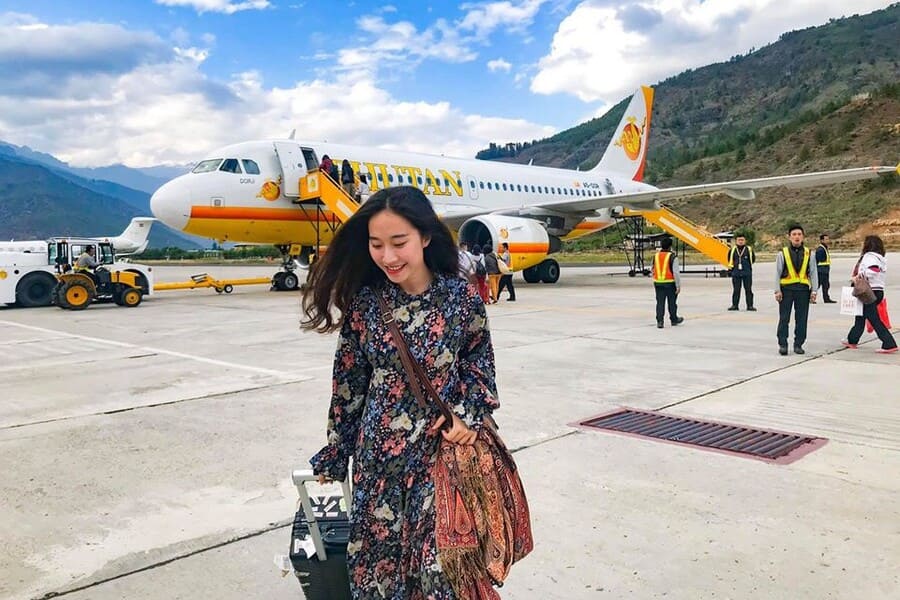
Bhutan has only one international airport — Paro International Airport — and only two airlines are licensed to fly there: Druk Air (Bhutan's national carrier) and Bhutan Airlines.
This limited air access means that flight prices to Bhutan are generally higher than comparable regional routes, and availability can be tight during peak seasons (spring and autumn).
Typical return flight costs from major departure cities:
| Departure City | Approximate Round-Trip Cost |
|---|---|
| Bangkok, Thailand | USD 350–500 |
| Delhi, India | USD 250–400 |
| Kathmandu, Nepal | USD 280–420 |
| Singapore | USD 450–650 |
| London, UK | USD 900–1,400 (including connection) |
| New York, USA | USD 1,200–1,800 (including connection) |
| Sydney, Australia | USD 900–1,400 (including connection) |
Most travelers from Western countries fly to Bangkok or Delhi first (on a major international carrier), then connect to Paro on Druk Air or Bhutan Airlines. This connection routing typically adds one night to the trip on the outbound journey.
Booking tip: Book Bhutan flights as early as possible — ideally 3–6 months ahead for peak season travel. Flights fill quickly and prices rise sharply close to departure.
Accommodation Costs in Bhutan
Bhutan offers a surprisingly wide range of accommodation options, from simple guesthouses to some of Asia's most celebrated luxury lodges.
Budget Guesthouses and Local Hotels
Small family-run guesthouses and budget hotels in Bhutan typically cost USD 40–80 per room per night. They are clean, comfortable, and offer genuine insight into Bhutanese hospitality. Breakfast is usually included.
Mid-Range Hotels
Comfortable three-to-four-star hotels — typically well-appointed, with valley views, traditional Bhutanese architectural design, and good restaurants — range from USD 80–200 per room per night.
Boutique Heritage Hotels
Properties like Zhiwa Ling Heritage in Paro or Namseling Boutique Hotel in Thimphu offer exceptional character and craftsmanship at USD 150–300 per room per night.
Luxury Lodges and Resorts
Bhutan's luxury tier is extraordinary. Properties like the Amankora circuit (five lodges across the country), Six Senses Bhutan (five lodges), and Como Uma Paro sit at the apex of global hospitality. Rates begin at approximately USD 600–800 per room per night and rise to over USD 2,000 for premium suites.
For most international travelers, mid-range to boutique accommodation represents the sweet spot — offering genuine quality, immersive Bhutanese atmosphere, and meaningful comfort without reaching the heights of the ultra-luxury tier.
Food and Dining Costs in Bhutan
Food costs in Bhutan are relatively modest compared to Western countries.
Most standard Bhutan tour packages include all meals — breakfast, lunch, and dinner — as part of the package price. This is the norm rather than the exception, and it removes the need to budget separately for most dining.
If you are eating outside of your package arrangement:
- A meal at a local Bhutanese restaurant: USD 5–15
- A meal at a mid-range restaurant in Thimphu: USD 15–25
- A meal at a luxury hotel restaurant: USD 30–60
- A beer (local brands like Druk 11000 or Red Panda): USD 2–5
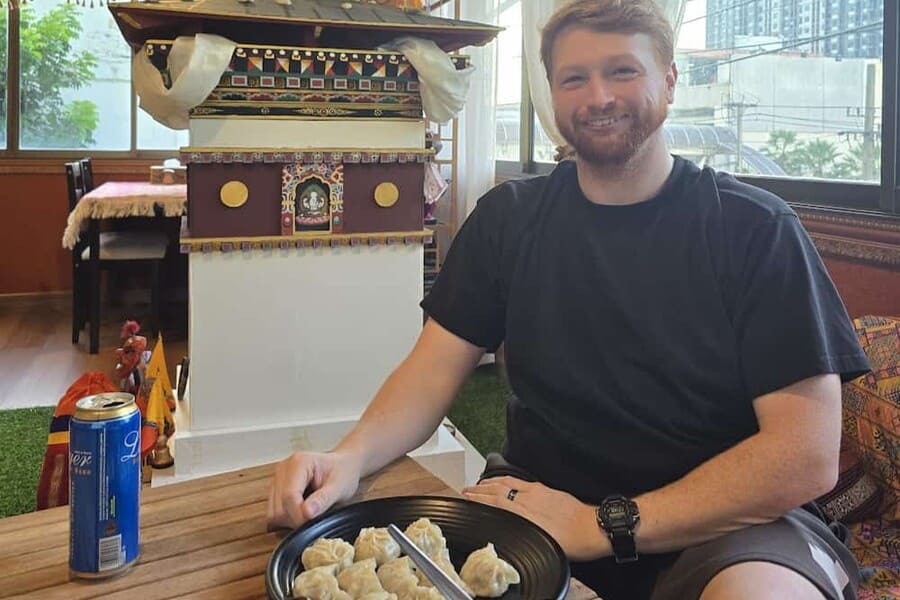
Bhutanese cuisine is hearty, spicy, and genuinely delicious. The national dish — ema datshi (chilli and cheese stew) — is served at virtually every meal. Red rice, momos (dumplings), and phaksha paa (pork with dried chilli) are staples. Vegetarians are well catered for, though vegans may need to be specific about dairy, which appears in many dishes.
Activity and Entrance Fee Costs
Most major site entrance fees in Bhutan are modest and are typically included in standard tour packages. For reference:
| Activity/Site | Approximate Cost |
|---|---|
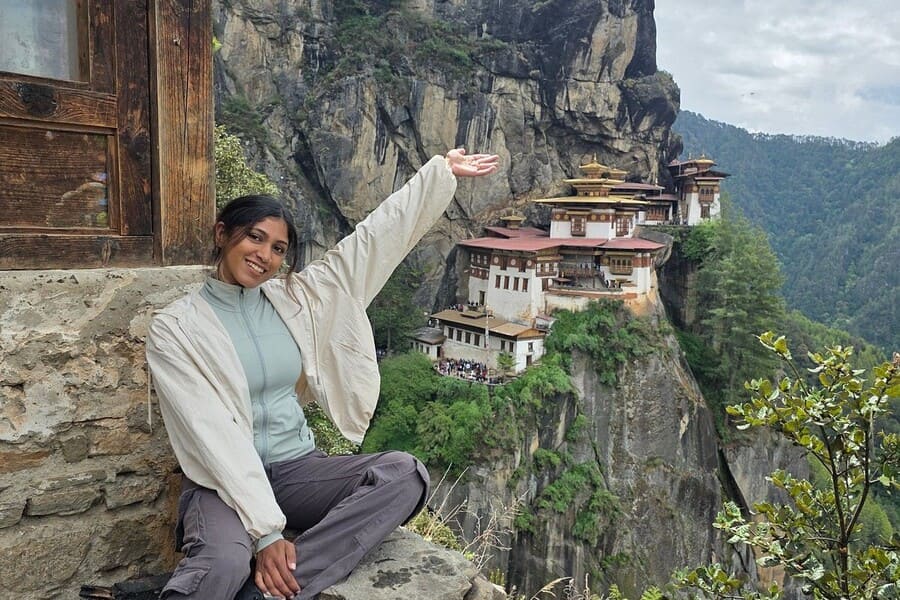
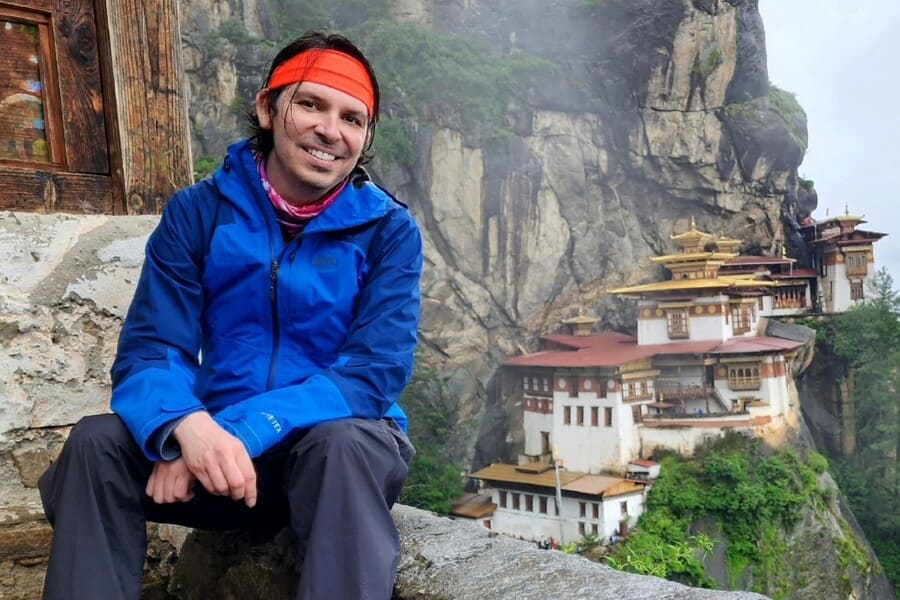
| Tiger's Nest Monastery (Paro Taktsang) | BTN 500 (~USD 6) |
| Rinpung Dzong, Paro | Included in tour |
| Punakha Dzong | Included in tour |
| Buddha Dordenma, Thimphu | Free |
| National Museum, Paro | BTN 300 (~USD 3.50) |
| Trekking permits | USD 25–50 per day, per person |
| White water rafting (Mo Chhu, Punakha) | USD 50–80 per person |
| Hot stone bath (at resort or farmhouse) | USD 20–50 |
| Archery lesson with locals | USD 15–30 |
Most of these are minor line items in the context of a full Bhutan trip budget. The trekking permits, if you are doing a multi-day trek, are the notable exception.
Tipping Costs in Bhutan
Tipping is expected in Bhutan and is an important part of your local guide's and driver's income. Budget the following as personal expense:
- Tour guide: USD 15–20 per day (or USD 100–150 per week)
- Driver: USD 8–10 per day
- Hotel/guesthouse staff: USD 1–2 per night is appreciated
- Trekking guide: USD 10–15 per day
- Trekking kitchen/camp crew: USD 5–8 per person per day
These are recommended ranges, not rigid rules. If your guide goes above and beyond — which in Bhutan, they often do — tip accordingly.
Sample 7-Day Bhutan Trip Budget (Three Price Tiers)
The following examples assume one person, 7 nights in Bhutan, with international flights from Bangkok included.
Budget Traveler (Comfortable but Simple)
| Item | Cost (USD) |
|---|---|
| Bhutan SDF (7 nights × $100) | $700 |
| Round-trip flights Bangkok–Paro | $400 |
| Accommodation (7 nights, guesthouse) | $420 |
| All meals (included in package) | $0 |
| Activities (inc. Tiger's Nest) | $80 |
| Tipping (guide + driver) | $140 |
| Personal spending | $100 |
| Total (approx.) | ~$1,840 |
Mid-Range Traveler (Comfortable, Quality Experience)
| Item | Cost (USD) |
|---|---|
| Bhutan SDF (7 nights × $100) | $700 |
| Round-trip flights Bangkok–Paro | $450 |
| Accommodation (7 nights, 3-star) | $840 |
| All meals (included in package) | $0 |
| Activities + extras | $200 |
| Tipping | $160 |
| Personal spending | $200 |
| Total (approx.) | ~$2,550 |
Luxury Traveler (Premium, Boutique Experience)
| Item | Cost (USD) |
|---|---|
| Bhutan SDF (7 nights × $100) | $700 |
| Round-trip flights Bangkok–Paro | $500 |
| Accommodation (7 nights, luxury lodge avg.) | $3,500 |
| All meals (included in premium package) | $0 |
| Private activities + premium extras | $500 |
| Tipping | $200 |
| Personal spending | $300 |
| Total (approx.) | ~$5,700 |
Sample 10-Day Bhutan Trip Budget
A 10-day trip allows you to cover more of Bhutan — typically adding Bumthang or Gangtey Valley to the classic Paro–Thimphu–Punakha circuit.
Mid-Range Traveler (10 days, from Bangkok)
| Item | Cost (USD) |
|---|---|
| Bhutan SDF (10 nights × $100) | $1,000 |
| Round-trip flights Bangkok–Paro | $450 |
| Accommodation (10 nights, 3-star avg.) | $1,200 |
| Meals (included) | $0 |
| Activities | $250 |
| Tipping | $200 |
| Personal spending | $250 |
| Total (approx.) | ~$3,350 |
How to Get the Best Value on a Bhutan Tour
Travel in the shoulder season. While spring (March–May) and autumn (September–November) offer the best weather, the monsoon season (June–August) and winter (December–February) bring lower accommodation rates and smaller crowds. The SDF is fixed regardless of season.
Travel as a couple or small group. The solo traveler supplement — an additional cost applied because guides and drivers are shared costs — is eliminated when traveling with a companion. Couples traveling together save significantly per person compared to solo travelers.
Book early. Flights to Bhutan are limited and fill quickly in peak season. Early booking secures better availability and prevents paying premium last-minute fares.
Choose your accommodation tier thoughtfully. The SDF is a fixed cost regardless of where you sleep. Spending modestly on accommodation and more on unique experiences (a private monastery blessing, a hot stone bath, a farmhouse lunch) often results in a richer trip than paying for luxury bedding.
Work with a local specialist. Tour packages arranged through a licensed Bhutanese operator, like Go Bhutan Tours, ensure that every aspect of your trip — from permit logistics to guide selection to itinerary pacing — is handled by someone who knows Bhutan intimately. This protects your investment and dramatically improves your experience.
Is Bhutan Worth the Cost?
This is the question every budget-conscious traveler asks. The honest answer is: almost invariably, yes.
The travelers who return from Bhutan speaking of it as the most profound experience of their travels are not, typically, people for whom the cost was trivial. They are people who weighed the expense carefully, committed to it, and found that what Bhutan delivered could not be measured in the same currency they used to compare hotel rates.
There are places you visit. And there are places that change you. Bhutan, for the vast majority of those who go, is the second kind.
The cost buys you more than a holiday. It buys you access to a country that has chosen, deliberately and constitutionally, to measure its success in happiness rather than growth — and has quietly created a world that looks and feels nothing like anything most of us have ever seen.
That is not available at the budget tier. But at the mid-range level, it is thoroughly and genuinely affordable for travelers from most Western countries.
FAQs About Bhutan Travel Costs
How much does it cost to visit Bhutan per day? The SDF is USD 100 per person per night. Add accommodation (USD 40–300+ depending on tier), meals (usually included in packages), and activities. A mid-range day in Bhutan typically costs USD 150–250 per person all-in, excluding international flights.
Is the $100 SDF per person per night? Yes. The current SDF is USD 100 per person per night, charged for every night you spend in Bhutan. It is paid through your licensed tour operator and is not an at-the-border fee.
What is included in a Bhutan tour package? Standard Bhutan tour packages typically include: all accommodation, all meals, a licensed guide, a private vehicle and driver, all internal transfers, entrance fees to major sites, and the SDF. International flights are almost always excluded.
Is there a cheap way to visit Bhutan? Bhutan's tourism model requires all visitors to engage with a licensed operator and pay the SDF. There is no "budget backpacker" route. However, traveling in low season, choosing guesthouse accommodation, and traveling as a couple can reduce costs meaningfully.
How much spending money do I need for Bhutan? For personal expenses beyond your tour package — tips, souvenirs, extra drinks, optional activities — budget USD 100–200 per week for a mid-range traveler. Bhutan is not an expensive country for incidentals once your package costs are covered.
Do Bhutan tour prices include flights? Typically no. International flights to Paro are arranged and priced separately. Your tour operator can assist with booking Druk Air or Bhutan Airlines connections from your chosen gateway city.
When is Bhutan cheapest to visit? The monsoon season (June–August) and winter (December–February) bring lower accommodation rates and less demand on guides and transport. The SDF remains USD 100 per night regardless of season.