
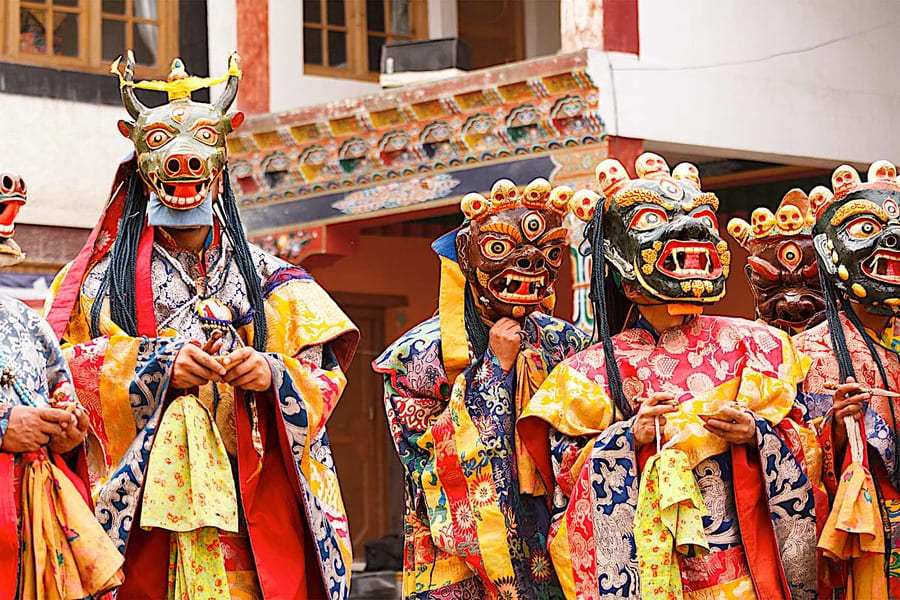
Few experiences in travel can rival the sight of crimson-robed monks spinning in elaborate costumes beneath the open sky of the Himalayas. The cham dance is one of the most profound and visually spectacular ritual traditions in Tibetan Buddhism, a sacred performance that has captivated spiritual seekers, anthropologists, and curious travelers for centuries. Whether you are planning bhutan tours or simply deepening your understanding of Himalayan culture, exploring the world of the cham dance offers a window into a living spiritual tradition that has endured for over a thousand years.
What Is Cham Dance?
The cham dance is a form of sacred ritual performance practiced within Tibetan Buddhist monasteries and temple courtyards. Unlike secular dance or theatrical performance, it is considered an act of worship, a moving meditation, and a vehicle for transmitting spiritual blessings to all who witness it.
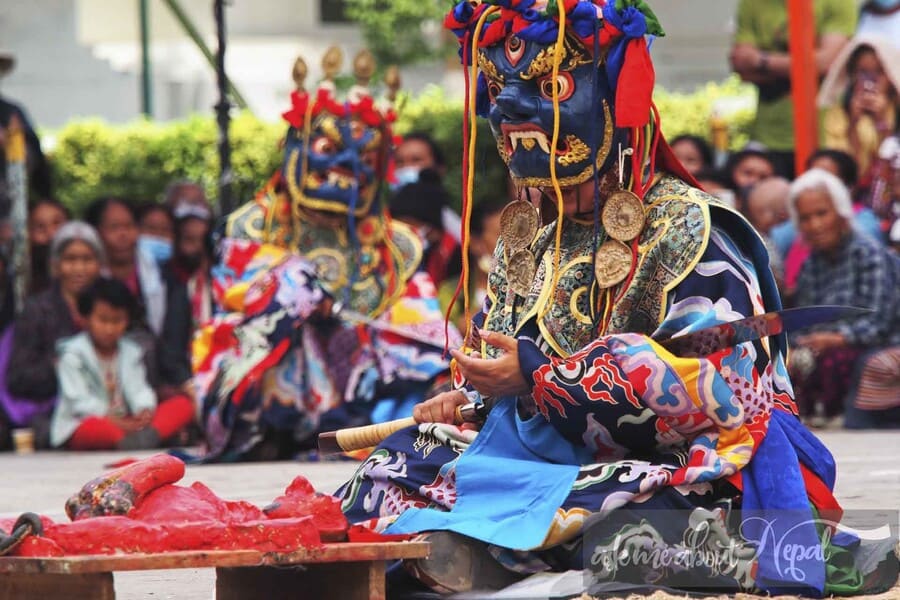
Performed by trained monks and lamas, the cham dance features elaborately crafted masks representing deities, demons, animals, and cosmic forces. The dancers move in precise, stylized patterns dictated by ancient religious texts, enacting narratives drawn from Buddhist scripture and the lives of revered teachers.
For observers unfamiliar with its context, the cham dance may appear exotic or theatrical. But within its own tradition, it is understood as a direct manifestation of enlightened energy. The movements, costumes, and music are not artistic choices but sacred prescriptions, each carrying deep symbolic meaning that practitioners have preserved with meticulous care across generations.
The Origins and History of Cham Dance
The origins of the cham dance are most commonly traced to the 8th century, when the great Indian master Padmasambhava, also known as Guru Rinpoche, introduced Vajrayana Buddhism to Tibet and the Himalayan region. Historical accounts suggest that Padmasambhava performed the first cham dance at Samye Monastery in Tibet to consecrate the ground, subdue local spirits, and remove obstacles before the monastery's construction could be completed.
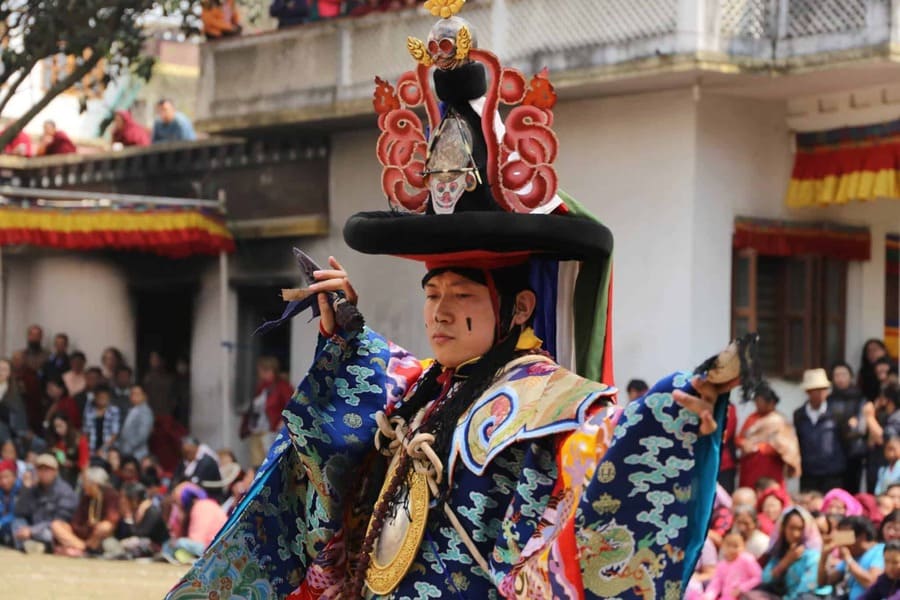
From this foundation, the tradition spread across the Himalayan world, adapting to local cultures while preserving its core spiritual framework. Different Buddhist schools, including the Nyingma, Kagyu, Sakya, and Gelug traditions, each developed their own distinct cham dance repertoires, with variations in costume design, musical accompaniment, and narrative content.
The practice reached the Kingdom of Bhutan in the 17th century under the profound influence of Zhabdrung Ngawang Namgyal, the Tibetan lama who unified Bhutan as a nation. He introduced structured tshechu festivals, during which cham dance performances became a central feature of national religious and cultural life. Today, cham dance bhutan festivals remain among the most important events in the Bhutanese cultural calendar, drawing both devout pilgrims and international visitors alike.
In Tibet itself, the cham dance tradition suffered severe disruptions during the Cultural Revolution. Many monasteries were destroyed and their traditions forcibly interrupted. However, the practice survived in Bhutan, Nepal, Sikkim, Ladakh, and among Tibetan communities in exile, ensuring its continuity into the present day.
How Is Cham Dance Performed?
The performance of the cham dance is governed by detailed instructions preserved in sacred texts. Nothing is improvised. Every gesture, every step, and every pause has been handed down through lineages of trained teachers.
Ritual Preparations
Before any performance begins, extensive ritual preparation takes place behind monastery walls. Monks who will perform the cham dance undergo a period of purification that may involve fasting, prayer, meditation, and the recitation of specific mantras. This preparation is understood not as rehearsal in the theatrical sense but as a spiritual process of embodying the deity whose form the dancer will assume.
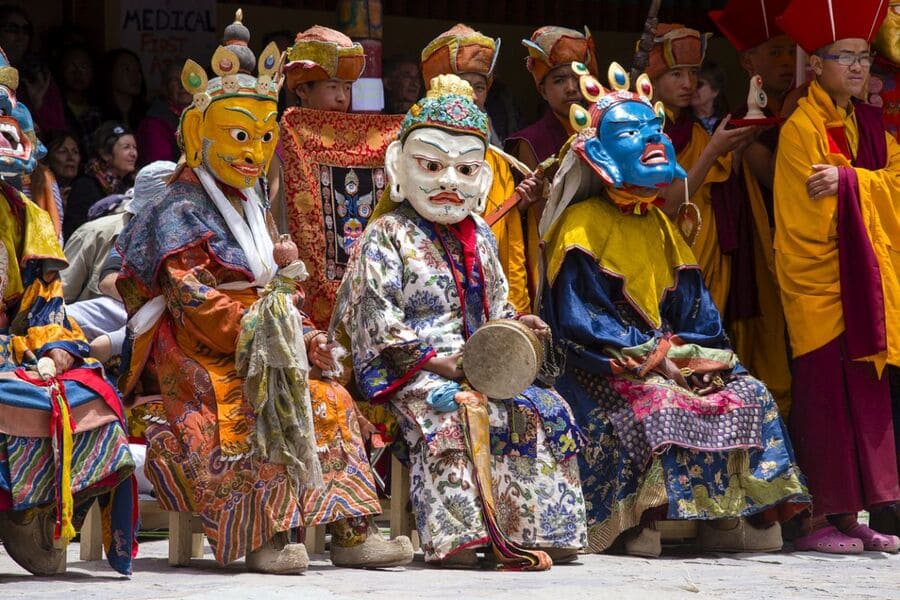
The elaborate masks and costumes are themselves treated as sacred objects. Before being worn, they are consecrated through ritual. The masks are stored with respect in monastery storerooms and handled according to prescribed protocols. Monks may spend days preparing the costumes, repairing masks, and ensuring that every element of the performance apparatus is spiritually and physically ready.
The performance space, typically a monastery courtyard, is prepared and blessed. The cardinal directions may be marked, and ritual offerings are arranged. The assembled audience, whether of devout lay practitioners or curious travelers, is considered a participant in the spiritual event, not merely a passive observer.
Music, Drums, and Traditional Instruments
The soundscape of the cham dance is as distinctive as its visual spectacle. A large ensemble of monks provides continuous musical accompaniment using instruments that have been part of the Tibetan Buddhist tradition for centuries.
The dungchen, an extraordinarily long telescoping horn that can extend several meters, produces a deep, resonant drone that seems to vibrate through the earth itself. Gyaling, a kind of oboe with a piercing, nasal tone, carries melodic lines above the drone. Rolmo, large hand cymbals, mark rhythmic accents with metallic crashes, while nga, large ceremonial drums, provide the fundamental pulse that structures the dancers' movements.
The music of the cham dance is not background accompaniment but an integral element of the ritual. Different melodic and rhythmic patterns correspond to different sections of the ceremony, and experienced musicians must memorize extensive traditional compositions passed down through oral and written transmission.
The Sequence of the Dance
A complete cham dance performance unfolds in a carefully ordered sequence of individual dances, each featuring different characters and conveying different aspects of Buddhist teaching.
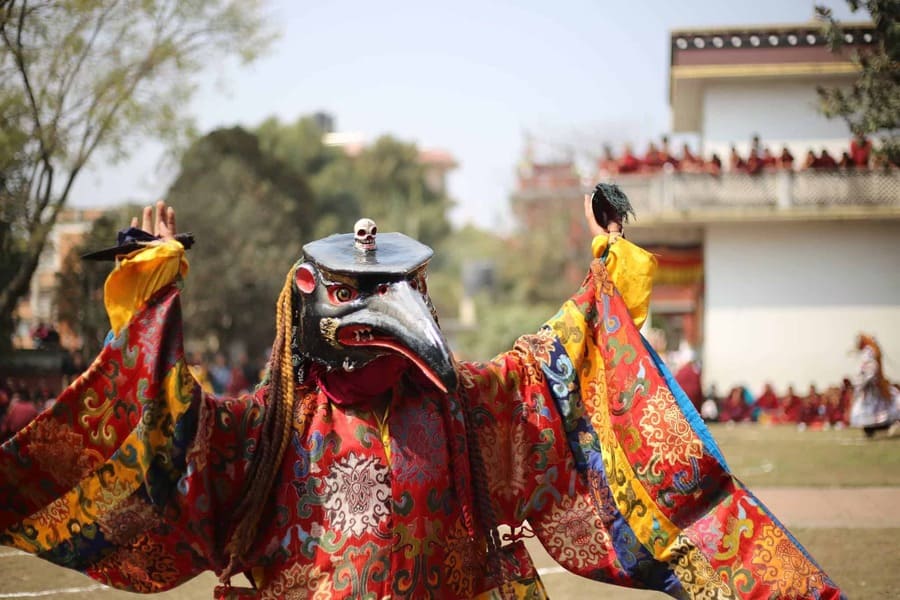
Performances often begin with dances featuring Black Hat Dancers, known in Tibetan as Zhana Ngakpa, who represent tantric masters with the power to subdue negative forces. Their slow, deliberate movements establish the ritual space and drive away harmful energies. This is followed by dances featuring wrathful deities, animal-headed protectors, and skeletal figures known as Citipati, who remind observers of the impermanence of life.
A highlight of many cham dance performances is the appearance of Mahakala, a powerful protector deity depicted with a fearsome blue or black face, multiple arms, and a crown of skulls. His dance is considered especially auspicious and is understood to remove obstacles from the lives of all who witness it with sincere devotion.
Many performances conclude with the ritual dismemberment of a symbolic effigy representing ego, ignorance, and the forces of negativity. This final act, carried out by the central deity figures, represents the destruction of obstacles to liberation and is considered a moment of collective purification for the entire audience.
When and Where Can You Watch Cham Dance in Bhutan?
Cham dance bhutan performances are most accessible to visitors during the annual tshechu festivals, which are held at major dzongs and monasteries throughout the country. These festivals follow the Bhutanese lunar calendar, so dates shift from year to year in the Gregorian calendar. Planning ahead is essential, as accommodation and tour bookings fill rapidly during these popular events.
Paro Tshechu
The Paro Tshechu is held in spring, typically in March or April, at the magnificent Rinpung Dzong in the Paro Valley. This five-day festival is one of the most celebrated in Bhutan and draws enormous crowds of pilgrims from across the country as well as international visitors.
The cham dance performances here are particularly spectacular, set against the backdrop of the imposing white dzong and the surrounding valley. The festival concludes with the pre-dawn unfurling of the Thongdrel, a massive thangka painting of Guru Rinpoche, which is believed to grant liberation from suffering to all who behold it. Arriving early on this final morning to witness the Thongdrel is considered one of the most profound spiritual experiences available to visitors in Bhutan.
Thimphu Tshechu
The Thimphu Tshechu, held in September or October at Tashichho Dzong in the capital city, is the largest tshechu festival in Bhutan. Over three days, extensive cham dance performances take place in the dzong's central courtyard, featuring a particularly wide repertoire of dances and an immense gathering of both monks and laypeople in their finest traditional dress.
Because Thimphu is Bhutan's capital and most accessible city, the Thimphu Tshechu is often the most convenient festival for first-time visitors to attend. The energy of tens of thousands of Bhutanese citizens in celebration, combined with the spiritual gravitas of the cham dance performances, creates an atmosphere that most travelers describe as deeply moving and unforgettable.
Punakha Drubchen
The Punakha Drubchen, held in February or March at Punakha Dzong, is technically a drubchen rather than a tshechu, but it features cham dance performances as a central element and is considered one of the most dramatic and historically significant festivals in Bhutan. The festival commemorates a historic battle in which Bhutanese warriors repelled a Tibetan invasion in the 17th century.
The cham dance performances here are accompanied by mock military reenactments, creating a uniquely dynamic spectacle that blends spiritual practice with historical memory. Punakha Dzong itself, situated at the confluence of two rivers and regarded as one of the most beautiful buildings in the Himalayas, provides an extraordinary setting.
FAQs About Cham Dance
What is the purpose of Cham Dance?
The cham dance serves multiple interrelated purposes within the Tibetan Buddhist tradition. At its most fundamental level, it is a form of ritual activity believed to generate spiritual merit and blessings for both performers and observers. The performance is understood to purify negative karma, subdue harmful forces, and create auspicious conditions for the surrounding community.
The cham dance also serves a pedagogical function, conveying Buddhist teachings about impermanence, compassion, the nature of mind, and the reality of enlightened beings through visual and kinesthetic means that transcend language. In communities where literacy was historically limited, such performances were a primary vehicle for transmitting the essence of Buddhist philosophy.
Is Cham Dance only performed in Bhutan?
No. While cham dance bhutan festivals are among the most accessible and well-preserved examples of this tradition for international visitors, the cham dance is performed across the Himalayan Buddhist world. It can be witnessed in Tibet, Nepal, Sikkim, Ladakh, Arunachal Pradesh, and Mongolia, as well as in Tibetan Buddhist communities in the West. Each regional tradition has its own distinct character, repertoire, and aesthetic, though the underlying spiritual framework is shared.
Can tourists attend Cham Dance festivals?
Yes, visitors are generally welcome to attend cham dance performances at Bhutanese tshechu festivals and at many equivalent festivals in Nepal and Ladakh. In Bhutan, tourists must travel with a licensed guide, and the government's daily tourist tariff applies throughout any visit. This system helps manage visitor numbers and ensures that tourism revenues support local communities. Visitors are expected to behave respectfully, dress modestly, avoid obstructing the view of local worshippers, and follow the guidance of their guides regarding photography and movement within the performance space.
Why do dancers wear frightening masks?
The fearsome appearance of many cham dance masks reflects the wrathful aspect of compassion in Tantric Buddhist iconography. Wrathful deities are not understood as malevolent beings but as enlightened forces whose fierce appearance serves to terrify and subdue the forces of ego, delusion, and harm. Their frightening visages represent the intensity of wisdom cutting through ignorance.
From an artistic and cultural standpoint, the masks are masterpieces of traditional craft, created by skilled artisans using papier-mache, wood, or clay, and painted with mineral pigments according to precise iconographic specifications. Each color, shape, and ornament carries specific symbolic meaning traceable to ancient texts.
How long does a Cham Dance performance last?
A single cham dance festival typically spans three to five days, with performances occurring each day from morning into the afternoon. On any given day, the cham dance program may run for four to eight hours, with different dances following one another in a prescribed sequence. Individual dances within the sequence can last anywhere from fifteen minutes to over an hour depending on their complexity and significance.
Visitors need not attend every moment to have a meaningful experience. Even a few hours spent watching the cham dance performances, absorbing the music, the color, and the devotional atmosphere, can leave a lasting impression that deepens one's appreciation of Himalayan Buddhist culture.