
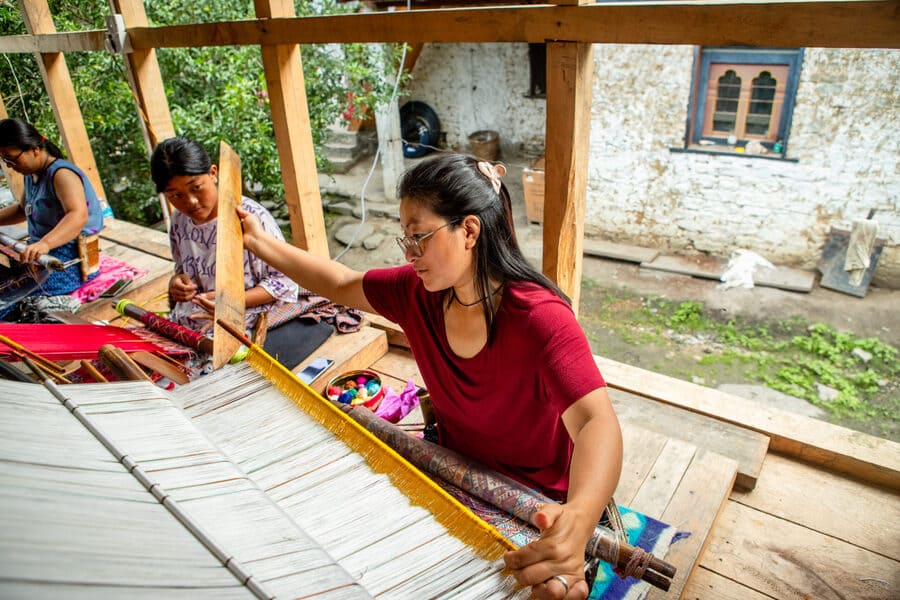
Bhutan is a country that guards its traditions like precious heirlooms, passed from one generation to the next with extraordinary care. Among the many cultural treasures woven into the fabric of Bhutanese life, Kishuthara weaving Bhutan stands as one of the finest. And at the very heart of this ancient textile art lies a small, extraordinary settlement nestled deep in the valleys of eastern Bhutan: Khoma Village. For travelers who go beyond the standard itinerary to seek out something genuinely rare, a visit to this living cultural landmark is an experience that no photograph, souvenir, or highlight reel can fully capture. While most Bhutan tour packages focus on the western valleys of Paro, Thimphu, and Punakha, those that venture east to Khoma offer a unique opportunity to witness one of Bhutan's most treasured living traditions and connect with the country's rich cultural heritage at its source.
Khoma Village: A Cultural Gem in the Heart of Lhuentse
To find the purest expression of Bhutanese weaving tradition, you must journey eastward, away from the well-traveled valleys of Paro and Thimphu, into the district of Lhuentse. This remote and largely untouched region is considered the cultural cradle of Bhutan, the homeland of the Wangchuck royal dynasty, and a stronghold of ancient rituals, sacred architecture, and living craftsmanship.
Khoma Village Bhutan sits quietly within this landscape, sheltered by terraced rice fields and forested ridgelines. It is, by any standard measure, a small village. There are no grand monuments or tourist infrastructure. What draws the world to Khoma is something far more intimate: the women who live here, and the breathtaking silk textiles they produce entirely by hand.
The village is home to the most accomplished Kishuthara weavers in Bhutan. Their craft has earned Khoma a reputation that extends well beyond national borders. Travelers, textile scholars, cultural researchers, and anyone who appreciates genuine handmade artistry make the effort to reach this place specifically because of what the women here create.
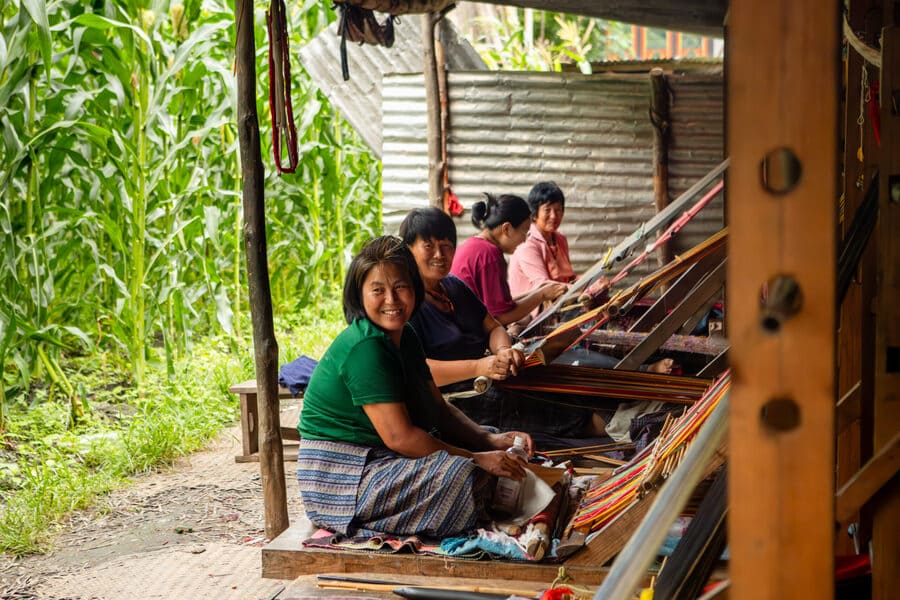
The setting itself mirrors the unhurried pace of the work. Traditional two and three-story wooden homes, with slate or timber roofing, line the hillsides. Looms are positioned on open verandas and porches, taking advantage of natural light. Weavers sit in quiet concentration, their fingers moving with an ease and precision that comes only from a lifetime of practice. Behind them, the mountains rise in silence. It is an image of extraordinary peace.
Reaching Khoma weaving village requires commitment. The roads into the area are narrow, often suitable only for small vehicles, with some sections requiring visitors to walk. This natural barrier has, perhaps intentionally, helped preserve the village's authenticity. Mass tourism has not arrived here. The looms still operate for the love of the craft and the continuation of tradition, not for the performance of it.
Kishuthara: The Most Exquisite Fabric in Bhutan
What Is Kishuthara?
The name Kishuthara combines two words from the local language: "Kishu," meaning silk, and "Thara," meaning pattern or design. Together they describe a handwoven silk textile of extraordinary complexity, used primarily to create the Kira, the traditional dress worn by Bhutanese women on ceremonial occasions, religious festivals, and important life events such as weddings.
Kishuthara weaving Bhutan is not merely a form of production. It is an art form. The fabric is considered the highest expression of Bhutanese textile culture, and a woman's Kira speaks volumes about her family's heritage, her personal aesthetic, and the craftsmanship of the weaver who made it.
The Distinguishing Characteristics of Kishuthara
What sets Kishuthara apart from all other Bhutanese textiles is the density and complexity of its patterning. The supplementary weft technique, the process of manually weaving additional threads into the fabric to create raised surface patterns, demands an extraordinary level of skill, concentration, and spatial memory.
Every pattern within a length of Kishuthara is woven thread by thread, row by row, without the assistance of any automated system. The geometric motifs, which commonly include the Druk (Bhutan's thunder dragon), the Tashi Tagye (eight auspicious symbols), and diamond-shaped lattices, are built entirely through the manual manipulation of hundreds of individual threads.
The color palette is another defining element. Natural dyes sourced from forest plants, tree bark, roots, minerals, and leaves produce colors that are simultaneously vivid and harmonious. These hues do not fade easily, and the combinations achieve a balance that synthetic dyes rarely replicate. The dyeing process itself is a closely guarded family knowledge, passed down through generations.
A single piece of Kishuthara fabric Bhutan of sufficient length to make a Kira can take anywhere from one month to six months to complete, depending on the intricacy of the design. Particularly elaborate pieces with full-coverage patterning and multiple colors may take an entire year. Given this investment of time and skill, the resulting textile commands a price that reflects its true value. A high-quality Kishuthara Kira can be worth as much as a motorcycle or a small vehicle, and it is treated accordingly.
Why Khoma Weavers Are Considered the Best
The superiority of Khoma Village Bhutan weavers is not accidental. It is the product of an unbroken transmission of knowledge, technique, and artistic standards across generations.
Girls in Khoma are introduced to weaving from early childhood. They begin with simple tasks such as winding thread and learning to manage the loom, gradually progressing to increasingly complex patterns. The knowledge is not written down or formally taught in classrooms. It is transferred directly, from mother to daughter and from grandmother to granddaughter, through observation, imitation, and patient practice.
Because Khoma is a small community removed from commercial pressures, the weavers have never been forced to simplify their techniques or lower their standards for the sake of mass production. Each piece is made with the same exacting care that characterized the craft centuries ago. This is the true source of Khoma's legendary status in the world of traditional weaving Bhutan.
The Weaving Culture of Khoma Village
Women as the Pillars of the Community
In Khoma, the women are the cultural and economic foundation of the village. Weaving is not a hobby or a supplementary income. It is central to identity, status, and daily life. Work at the loom begins after household tasks are completed in the morning and often continues well into the evening, accompanied by quiet conversation, singing, or focused silence.
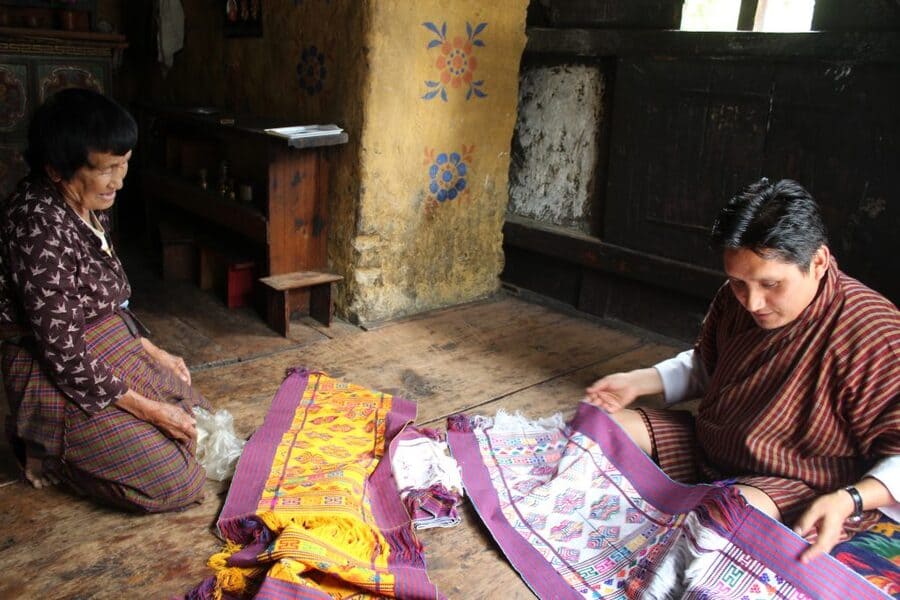
For a woman of Khoma, weaving a Kishuthara carries meaning that transcends commerce. It is a meditative practice, a creative act, and a form of cultural devotion all at once. The patience required to produce a single piece instills the qualities most valued in Bhutanese society: steadiness, care, and an unhurried commitment to doing things properly.
Natural Dyeing as Science and Tradition
Before a single thread is woven, the dyeing process must be completed. This stage is as demanding and skilled as the weaving itself.
Fibers, typically silk or cotton, are prepared and submerged in baths made from locally gathered natural materials. Turmeric yields warm yellows and golds. Indigo plants produce deep blues. Bark and roots from specific forest trees generate earthy reds and browns. The exact recipes, ratios, temperatures, and timing involved in producing consistent, high-quality dye results are family secrets, passed down orally and jealously protected.
The resulting colors possess a depth and luminosity that cannot be replicated by synthetic alternatives. They are part of what gives Kishuthara its unmistakable character.
Children Learning the Loom
The cultural transmission in Khoma begins at a remarkably young age. Children grow up surrounded by the sound and sight of weaving, absorbing the rhythms of the craft before they are formally taught. By the time a girl is ready to sit at the loom herself, much of the foundational understanding has already been absorbed through years of proximity and observation.
This early and organic introduction to the craft ensures that Kishuthara weaving Bhutan will not disappear. It also means that the weavers of Khoma carry a relationship with their work that is deeply personal, rooted in memory, family connection, and a sense of cultural responsibility.
The Weaving Process: Craftsmanship at Its Most Demanding
Step One: Fiber Selection and Natural Dyeing
The process begins with the selection of raw fibers. Silk is the preferred material for the most valuable pieces, while cotton is used for more accessible grades. Once selected, fibers are cleaned and prepared for dyeing.
The dyeing stage is performed entirely with natural materials. After dyeing, threads are dried carefully to preserve color integrity before being wound and prepared for the loom.
Step Two: Setting Up the Loom and Designing Patterns
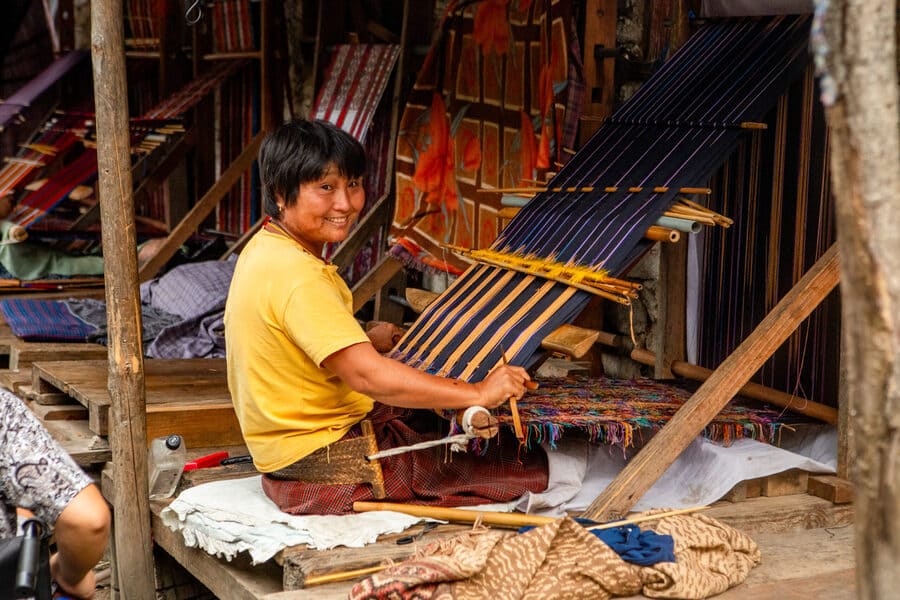
The back-strap loom is the primary tool of Khoma weavers. This traditional device uses the weaver's own body weight and posture to maintain tension on the vertical warp threads, requiring constant physical engagement throughout the weaving process.
Setting up the supplementary weft patterns for Kishuthara is perhaps the most intellectually demanding part of the entire process. Using small bamboo sticks, heddles, and knotted arrangements, the weaver encodes the entire design into the loom structure before a single row of decorative weaving begins. This preparation stage alone can take days.
Step Three: Weaving Row by Row
Once the loom is prepared, the actual weaving begins. Each row of the fabric's decorative pattern is produced by manually selecting specific warp threads, inserting the supplementary weft thread through, and compressing the row into place. This operation is repeated hundreds of times for each centimeter of patterned fabric.
There is no mechanical assistance, no template overlay, no shortcut. The entire design exists in the weaver's memory and is executed through the trained movements of her hands and eyes.
Step Four: Quality Control and Correction
Mistakes in Kishuthara weaving are inevitable, but the weavers of Khoma are known for their exacting standards. Regular checks are made to verify the symmetry, sharpness, and accuracy of patterns. When errors are identified, the weaver unravels the affected rows and reworks them until the result meets her own standards.
This commitment to quality over speed is part of what defines the Khoma weaving village tradition.
Step Five: Completion and Finishing
When the weaving is complete, the fabric is carefully removed from the loom and inspected in full. The finished Kishuthara is then used to make a Kira, a full-length textile wrap that serves as the formal dress for Bhutanese women. A Kishuthara Kira is among the most prized possessions a Bhutanese woman can own, and it is often preserved across multiple generations.
What Visitors Experience in Khoma Village
Watching Master Weavers at Work
The most profound experience Lhuentse Bhutan village visitors have in Khoma is simply watching the weavers at work. Unlike cultural performances staged for tourist consumption, the weaving in Khoma happens naturally, in domestic spaces, as part of ordinary daily life. Visitors are invited into that reality.
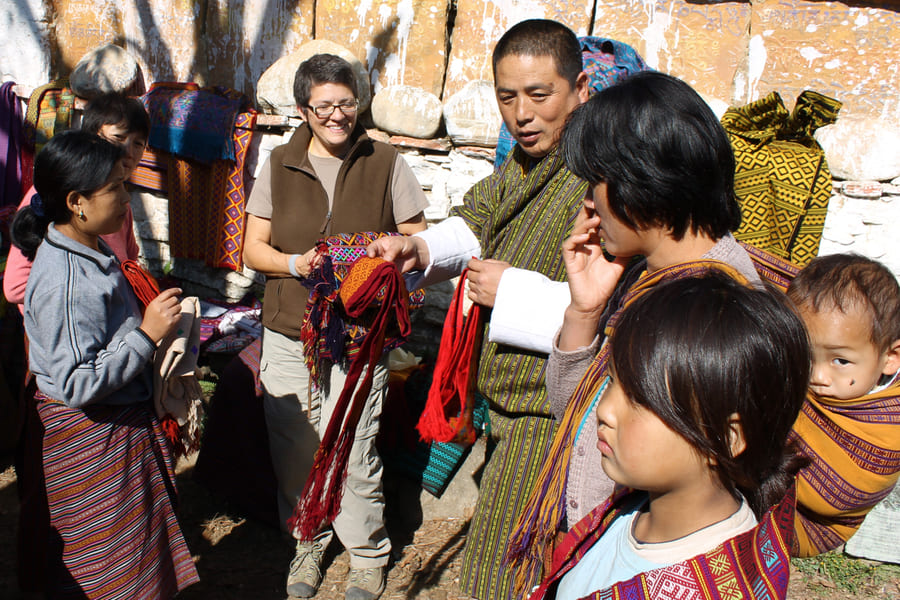
Watching a skilled weaver navigate the complexity of a Kishuthara pattern in real time, counting threads invisibly, moving with practiced ease, creates an appreciation for human craftsmanship that is difficult to find anywhere else.
Trying the Loom
Many households in Khoma welcome visitors to try weaving a few rows under guidance. The back-strap loom feels unfamiliar at first, and even simple weaving requires more physical coordination than expected. This brief hands-on encounter makes the complexity of Kishuthara far more comprehensible and leaves a lasting impression of what the craft truly demands.
Purchasing Kishuthara Directly from Weavers
Buying Kishuthara fabric or a finished Kira directly from the artisans in Khoma is one of the most meaningful purchases a traveler to Bhutan can make. It ensures that the full value of the piece goes directly to the weaver and her family. It also provides a direct connection between the buyer and the maker, transforming a transaction into a relationship.
The price of authentic Kishuthara reflects its true cost: months of skilled labor, rare natural dyes, and irreplaceable craft knowledge. Understanding this makes the purchase feel like the honor it is.
Exploring Traditional Architecture and Local Cuisine
The houses of Khoma are beautiful examples of traditional Bhutanese rural architecture. Built from timber and stone, typically on two or three levels with storage and livestock below and living spaces above, they offer insight into a way of life that has changed very little over centuries.
Visitors with access to local hospitality may also experience the regional cuisine of Lhuentse, including Ema Datshi, Bhutan's beloved chili and cheese dish; red rice with its distinctive nutty flavor; and stews made from dried meats and foraged mountain vegetables.
Price of Kishuthara
The price of an authentic Kishuthara typically ranges from US$1,500–2,000 for a high-quality handwoven piece, while exceptionally intricate ceremonial Kishutharas can cost US$3,000 or more. A single textile often requires 8–12 months of weaving, which explains its premium value.
The Cultural Significance of Khoma Village for Bhutan
Khoma Village Bhutan is more than a craft destination. It is a living argument for a particular philosophy of development and cultural preservation that Bhutan has championed at a national level through its Gross National Happiness framework.
Bhutan's approach to progress deliberately places cultural integrity, environmental sustainability, and community wellbeing above the pure pursuit of economic growth. Khoma exemplifies what this looks like in practice. The village has not simplified its weaving techniques to serve mass tourism markets. It has not mechanized or outsourced. It continues to do what it has always done, in the way it has always been done, because that is the standard that matters.
Kishuthara fabric Bhutan holds significant ceremonial importance as well. It is the required textile for Kiras worn at Tshechu religious festivals, weddings, royal events, and formal ceremonies. In Bhutanese society, a woman's Kishuthara Kira signals her family's history, her personal refinement, and her connection to cultural tradition. It is worn with pride and treated with reverence.
The village also demonstrates how a small, remote community can maintain cultural relevance not despite its isolation but because of it. Distance from commercial centers has protected Khoma from the homogenizing forces of tourism and mass market production. That protection has preserved something genuinely rare.
Tips for Visiting Khoma Village
Travel in small groups. The roads approaching Khoma are narrow and sometimes unpaved. Small vehicles and limited group sizes are strongly recommended. Organize your visit through a reputable licensed tour operator who has experience designing cultural itineraries in eastern Bhutan.
Respect the workspace. The loom is a weaver's professional tool and a significant piece of personal property. Never touch a loom, its threads, or its attachments without explicit permission. A minor disturbance can undo hours of careful work.
Ask before photographing. Always seek permission before taking photographs of individual weavers or inside homes. A friendly, respectful approach is universally appreciated in Khoma, and most people will agree when asked politely.
Dress modestly. Bhutan is a Buddhist country with strong values around appropriate dress and behavior. Wear clothing that covers shoulders and knees, and maintain a calm, respectful demeanor throughout your visit.
Budget for a purchase. If you can afford to buy a piece of Kishuthara, do so directly from the weaver. The price is significant because the work behind it is significant. Purchasing directly supports the continuation of the tradition you have traveled so far to witness.
Khoma Village: The Living Heart of Bhutanese Textile Heritage
A visit to Khoma Village Bhutan is one of the most genuinely enriching cultural experiences the Kingdom of Bhutan has to offer. It is not a museum exhibit or a curated performance. It is real life, lived in alignment with centuries of tradition, carried forward with dignity and extraordinary skill.
Every thread of Kishuthara woven in Khoma carries within it the patience of the woman who made it, the knowledge her mother gave her, and the spirit of a community that has chosen to honor the past while living fully in the present. To witness that, even briefly, is to understand something essential about what Bhutan is and why it matters.
For travelers seeking depth over surface, meaning over spectacle, and connection over consumption, Khoma weaving village offers something irreplaceable: a genuine encounter with one of the world's most beautiful living traditions.